Saturday, February 7th, 1:00pm - 4:00pm
with Jim Sweitzer
“Color gets the credit, but values do all the work!” How many times have you heard that saying?
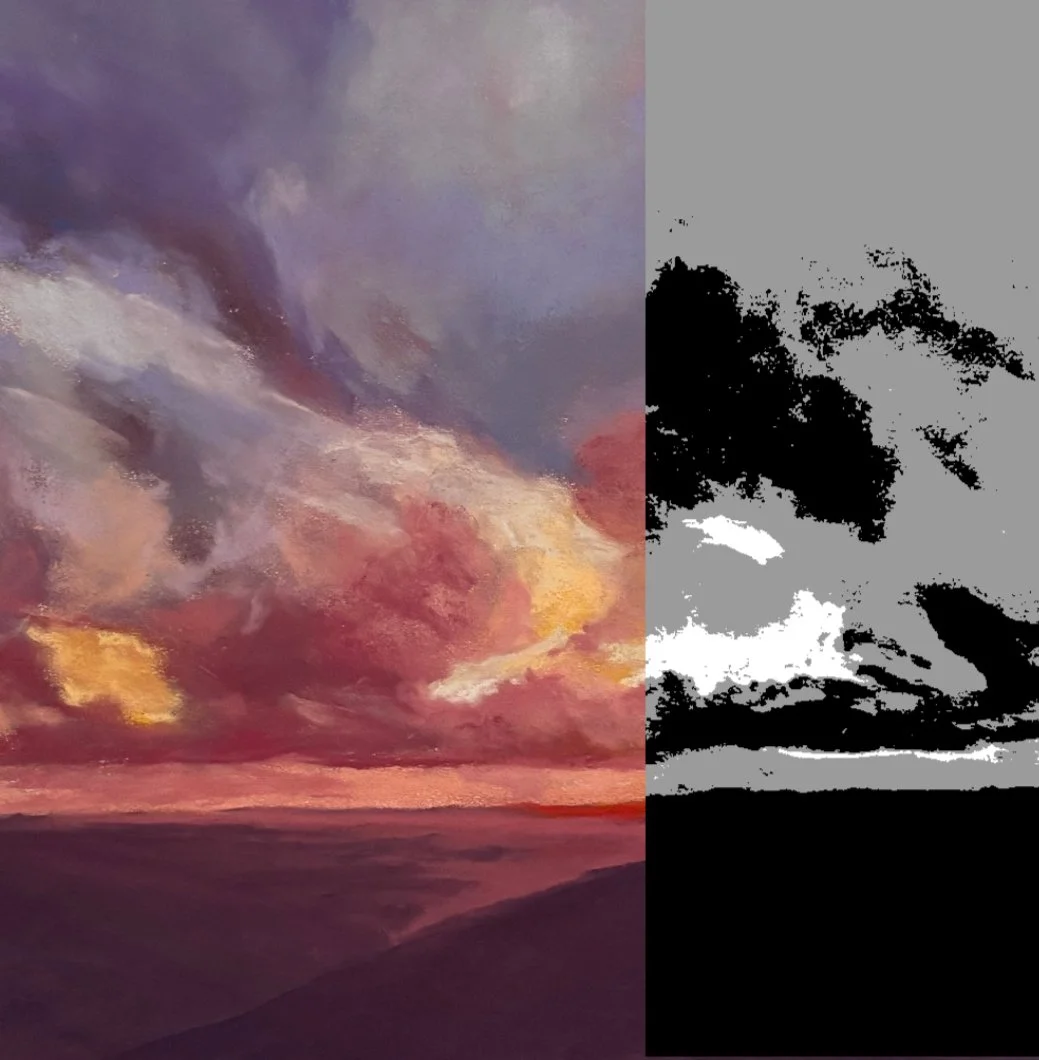
This one-day workshop is a “boot camp” to increase your ability to effectively use values in your art, no matter what the medium or the subject. It will explain the science of physiology behind the truth of this adage and examine the works of masters in employing the power of values in design.
But never fear; we won’t be painting value scales. We will use the latest tools and techniques, including cell phone apps, basic value guides, and grids. Materials and techniques will be kept simple, though, as they can be readily applied even to urban sketching sessions.
Finally, we will explore how best to use your new proficiency with values to plan and design your next work of art. This will include how certain design strategies are based on how our vision system operates. For example, we will work on exercises in sketchbooks using simple black and grey scale markers to explore our pictures in Notan (a Japanese word meaning dark-light). You are encouraged to bring photos of projects you’re planning, and hopefully, you will leave the session with some trial thumbnail sketches that use values in effective designs.
Registration and Fees
Become a member of the Oak Park Art League and save on class registration.
Members: $125.00; after 2/2/2026: $145.00
Non-Members: $145.00; after 2/2/2026: $165.00
Advanced Registration Required.
Registration and Code of Conduct Policy
Materials:
Materials List – Values and Composition Workshop
Mixed Media Sketchbook. You have to have one where markers won’t bleed through. It needn’t be large, 5.5”x8.5” will work for this session. If you don’t have something suitable, then the Canson Mixed Media sketch book in their artist’s series will work well and isn’t too expensive. (https://a.co/d/aEz2JXl)
Pencil and eraser – HB or harder
Grey Scale Watercolor Markers that can be used to paint a number of values from nearly black through light greys. You’ll use them in the class and they will be valuable to you when doing value studies and thumbnails in your future projects. I recommend this small set: Ecoline Grey – 5 Brush Pens (https://a.co/d/7OPmrN6) … (Alternatively, Tombow dual brush markers will also work if you already have a set.)
Value guide, if you have one.
Cell Phone Apps. Download the following two apps onto your phone. I’ll teach you how to use them effectively. Search for the names listed below. They should be available for both Apple and Android phones and are only a few dollars, I believe. (You may use them on an iPad or tablet if you prefer, but the phones are sufficient and actually handier.)
Notanizer
GridPainter
3 Photos of subjects you’re considering painting or drawing later. You may bring prints or you may have them on your phone too. They can be most any subject, but portraiture might not be the best choice unless the photo is more than just a straight on shot. The goal will be to try and tackle complex or challenging photos to see if you can crop and design them for later.
Feel free to bring anything else you might like to use in doing design sketches – but note we won’t be working directly with colors this time. A black, indelible felt pen like a Micron could be useful for marking up your designs.
About the instructor:
Most people would identify me as an astrophysicist. They are correct. After receiving my PhD in Astrophysics from the University of Chicago, I have spent much of my career in astronomy and museum education. For example, I was part of a team from the University of Chicago that created the first astronomical observatory at the South Pole. I was also Assistant Director of the Adler Planetarium in Chicago and Director of Special Projects for the Rose Center for Earth and Space at the Haydn Planetarium in New York City.
But over the years, I also began to “dabble” more and more in art, at first, to be able to converse with my mother and sister who were both accomplished watercolorists. As I look back on that development, I can point to several influences, interests, and sources of inspiration and formation, including: teaching science to artists at the School of the Art Institute, Chicago; over 20 years of courses at the Oak Park Art League; special courses in portraiture and figurative art at Vitruvian Studios, in Rome and Raw Umber Studios. My media of choice are graphite, watercolor and pastels. I focus primarily on portraiture and figurative subjects, but enjoy plein air painting and urban sketching. And, of course because of my science background, I have an abiding interest in how human perception and the science of light affect art.